Agentic Engineering
Agentic engineering. Fast is easy. Finished is what matters.
Agentic engineering is a way of building software in which AI agents do a large share of the implementation inside a defined workflow, while senior engineers own the definition, review, and release of every change. It’s how we build, and it’s what we help your team adopt.
“The agent brings the speed. The people and the system around it bring the safety.”
How we work
The AI Maturity Ladder
Most teams are on the first or second rung.
Every engineering partner says it uses AI. What matters is where the AI sits in the way the team ships.
-
Rung 1
AI-assisted
Individuals use copilots. Typing gets faster; delivery doesn’t change much.
-
Rung 2
AI-augmented
The team’s workflow is redesigned around AI. Faster tasks, but quality depends on each reviewer.
-
Rung 3 · Where we work
Agentic engineering
Agents implement inside governed loops. Senior engineers own the specification, the review, and the release.
The Loop
Agents carry the implementation. Seniors own the rest.
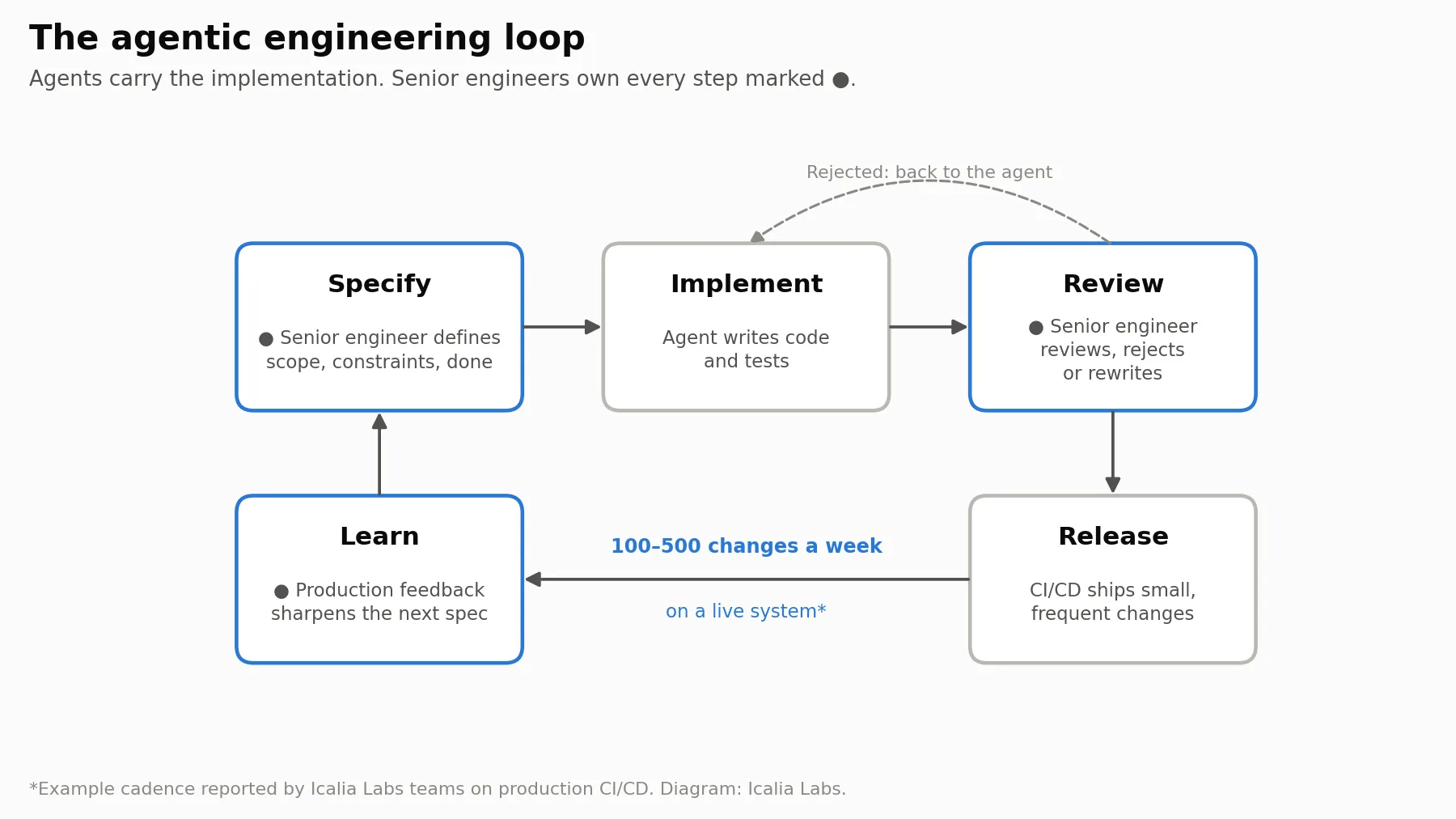
- 1. Specify. A senior engineer defines scope, constraints, and what “done” means, before any prompt.
- 2. Implement. Agents write the code and the tests inside that definition.
- 3. Review. A senior engineer reviews, rejects, or rewrites. Rejected work goes back to the agent.
- 4. Release. CI/CD ships small, frequent changes that are easy to test and roll back.
- 5. Learn. Production feedback sharpens the next specification.
Beyond the Prototype
“Looks ready” is not ready.
The cost of building a prototype has gone toward zero. Payments, real services, compliance, and maintenance haven’t. That’s where agentic work either becomes production software or becomes a demo nobody can maintain.
A feature someone built over a weekend with an agent still has to fit the architecture, pass the tests, and satisfy the compliance rules. In production systems where those stakes are real, finishing is the job.
When code costs almost nothing to write, someone senior has to decide what should not be written at all.
Fix the System, Not the Mistake
If the tests are thin, a faster team just ships more risk.
So the first work is usually around the code, not in it: specifications agents can follow, tests that run before any review, review loops where one serious finding stops a release, and pipelines that make small changes cheap.
From kickoff to a first version in production.
From 10 to hundreds of changes per week on live systems, each one reviewed.
Seeded defects caught by our open-source review loop, with no correct change blocked (one Rails app). How it works
Our senior engineers have been building with agents in production for at least the last year.
How Engagements Work
A high-throughput intervention, not a staffing plan.
Agentic Engineering usually starts fractional: senior experts working 15 to 20 hours a week alongside your leads, redesigning one workflow at a time. When you need more hands, forward deployed engineers join full time through Talent Augmentation.
Engagements bill time and materials. Outcomes are how we frame the value of the work, not a pricing promise.
FAQ
Frequently asked questions
What is agentic engineering?
Agentic engineering is a way of building software in which AI agents do a large share of the implementation inside a defined workflow, while senior engineers own the definition, review and release of every change.
What's the difference between AI-assisted, AI-augmented, and agentic engineering?
They're three rungs of a ladder. AI-assisted means individual engineers use copilots. AI-augmented means the team's workflow is redesigned around AI. Agentic engineering means agents implement inside governed loops, and senior engineers own judgment: the specification, the review and the release.
How does an engineering team adopt AI without losing quality?
Start with one real workflow, not a tool rollout. We write the specification before the prompt, wire agents into the work with tests and review guardrails in CI/CD, and measure time to production and change frequency against your current baseline. Then we widen it to the next workflow.
How do you keep AI-written code maintainable?
By building the system around the code for it. Agents implement inside a defined workflow, a senior engineer reviews every change before it ships, and the tests and conventions stay strong enough that the next change is easy too. If the pipeline is slow or the tests are thin, a faster team just ships more risk.
Does agentic engineering replace our engineers?
No. We work alongside your team. The specifications, guardrails and review habits we build stay with your engineers, and agents take on more of the execution while your people own more of the judgment.
How do engagements work and how do you bill?
Agentic Engineering usually starts as a fractional, high-throughput engagement: senior experts working 15 to 20 hours a week alongside your leads. Engineers can also join full time through Talent Augmentation. Engagements bill time and materials.
Ready to climb
the ladder?
A 30-minute call. If we’re not the right partner, you’ll hear that on the first one.