AI-Augmented Engineering Teams: What Buyers Pay For
Every engineering partner says it uses AI. Three metrics, five questions and the review standard that separate delivery outcomes from AI hype.

Eduardo Lopez De Leon · Co-Founder & CEO
· 6 min read

When an engineering partner says its engineers use AI, a buyer should be paying for faster, more frequent, reviewed delivery to production, not for more code. Three measurements show it: time from kickoff to first production release, change frequency on live systems, and output per engineer against a stated baseline. A partner that can't report them is selling a feature, not an outcome.
The short answer
As of 2026, nine in ten technology professionals use AI at work, according to Google's 2025 DORA report, and more than 80% believe it has made them more productive. Very few of the executives paying for that work can say what it has changed.
That gap is the difference between paying senior rates for senior judgment and paying senior rates for agent output nobody has checked. The rest of this piece covers how to tell the two apart:
- Know which of three ways of working the partner actually uses.
- Ask for outcome metrics, not adoption claims.
- Check who owns the specification and the review.
What does "AI-augmented" mean in an engineering team?
The label covers three very different ways of working. They are usually priced the same. They don't deliver the same.
| Level | What it looks like | Who owns quality | What changes for the buyer |
|---|---|---|---|
| AI-assisted | Autocomplete and chat in the editor | Each engineer, ad hoc | Slightly faster typing |
| AI-augmented | Engineers hand discrete tasks to agents and review the result | Each engineer | Faster tasks, uneven quality |
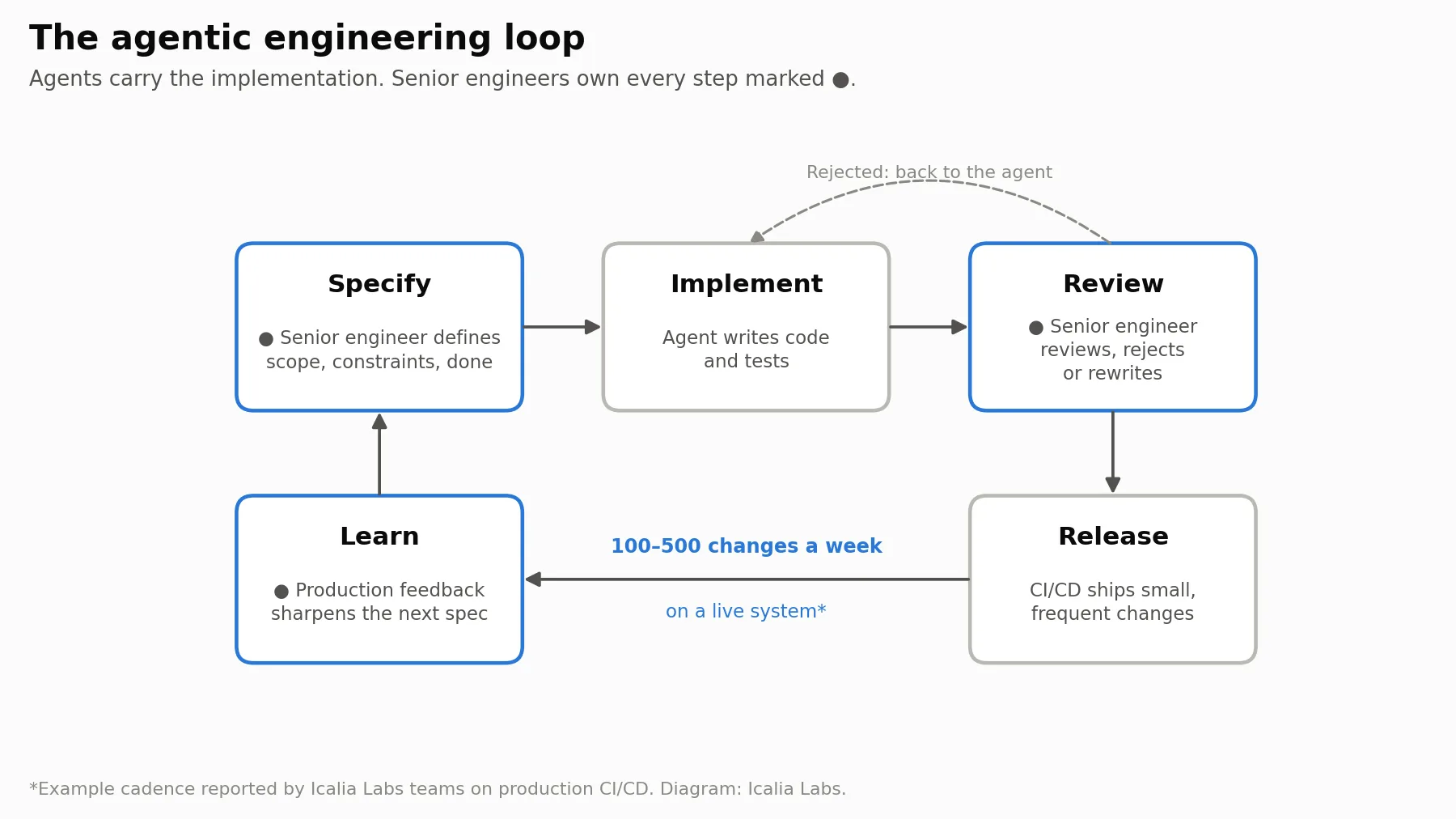
| Agentic engineering | Agents are built into the delivery workflow: specs before prompts, guardrails in CI/CD, senior review on every change | The team, by design | Faster, more frequent releases to production |
Agentic engineering is a way of building software in which AI agents do a large share of the implementation inside a defined workflow, while senior engineers own the definition, review and release of every change.
Most of the value, and most of the risk, sits between the second row and the third.
Why isn't "we use AI" evidence of anything?
Because it describes an input. Adoption is close to universal, and developer confidence in the output hasn't kept pace.
The 2025 Stack Overflow Developer Survey found that 84% of developers use or plan to use AI tools. Yet 46% actively distrust the accuracy of what those tools produce, and only 3% highly trust it. The most common frustration, cited by 66% of respondents, is "AI solutions that are almost right, but not quite." Almost half (45%) say debugging AI-generated code takes more time than expected.
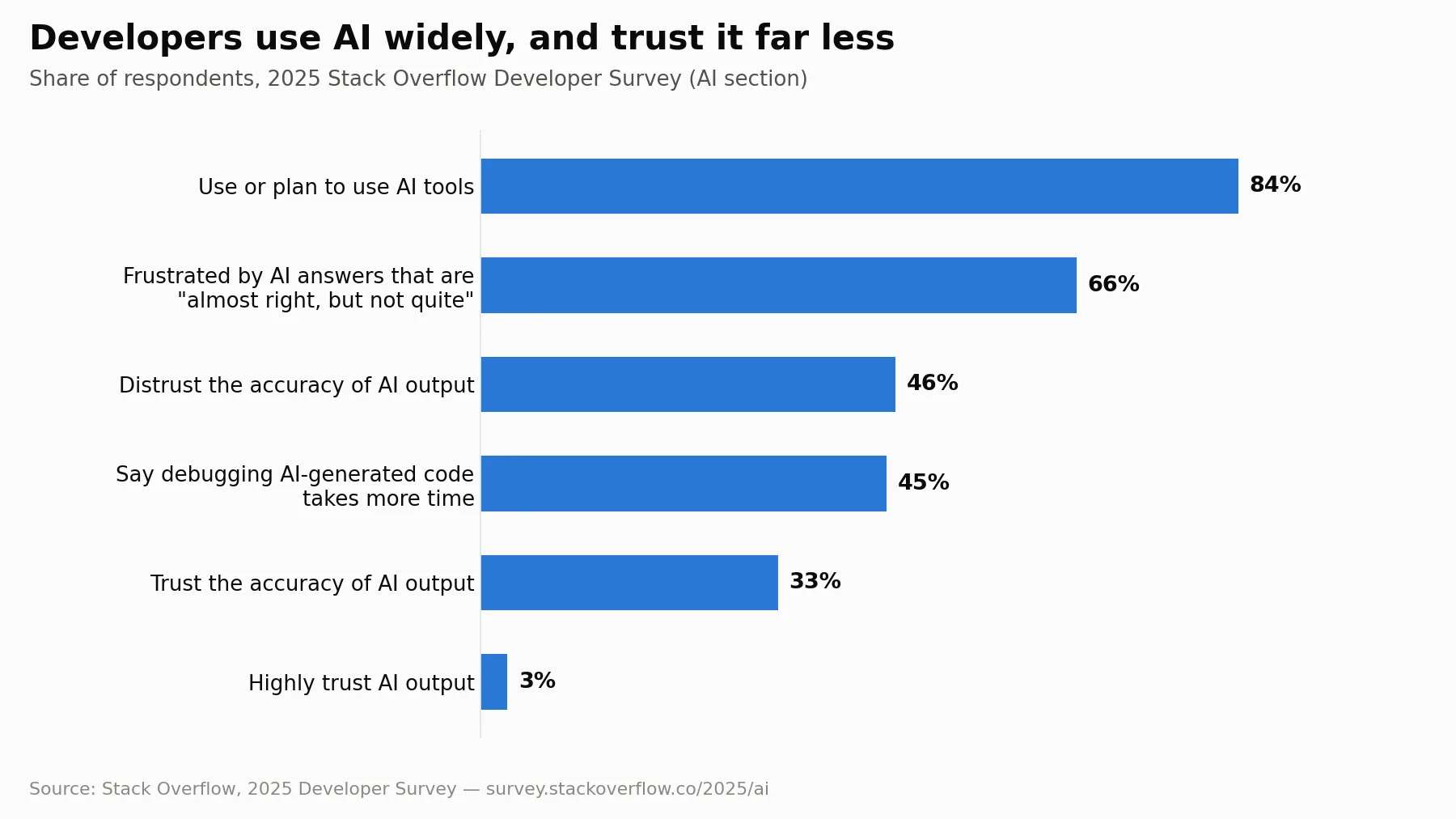
The DORA research shows the same pattern at the team level. AI adoption correlates positively with software delivery throughput, and it still correlates negatively with delivery stability. The report's central conclusion is that AI doesn't fix a team; it amplifies what's already there. Strong teams get better. Teams with weak testing, weak version control or slow feedback loops produce more change than they can safely absorb.
So the question for a buyer isn't whether a partner uses AI. It's whether the partner has the controls that turn AI speed into stable releases.
Doesn't AI make experienced engineers slower?
Sometimes, and the reason is instructive.
In a 2025 randomized trial, the research group METR followed 16 experienced open-source developers across 246 real tasks. When they were allowed to use AI tools, they took 19% longer to finish. They had expected a 24% speedup, and even afterward they believed AI had made them about 20% faster.
METR's early-2026 follow-up suggests developers are probably faster with current tools, but the researchers state that their new design can't yet measure by how much.
The lesson isn't that AI doesn't work. It's that perceived speed and measured speed can point in opposite directions, even for skilled engineers. A buyer who accepts a partner's feeling of productivity is accepting the least reliable number available.
Which metrics show an AI-native team is working?
The useful measurements are the ones a buyer can verify in their own repositories and pipelines.
Time from kickoff to first production release
This is the clearest test of whether a team can turn a definition into running software. A team that needs a month of setup before anything ships isn't getting much from its agents.
Change frequency on live systems
Small, reviewed changes are easier to test, easier to roll back and faster to learn from, which is the logic behind DORA's long-standing delivery metrics. Large, infrequent batches are where AI-generated code hides its mistakes.
Output per engineer, against a stated baseline
A productivity multiple means nothing without its unit and its baseline: "10x" what, measured how, compared with when?
What gets rejected in review
How often is agent output rejected or rewritten, and why? A partner that can't answer isn't reviewing systematically. A partner that says "never" isn't reviewing at all.
What this looks like in practice
Icalia Labs holds its teams to these numbers. According to Icalia Labs delivery data, first versions reach production in under a week, and teams working on production software with CI/CD push 10 - 100+ changes a week. Icalia Labs engineers deliver at least 10x productivity with AI-native tools compared to commit pushes in terms of PRs from 12+ months back, based on our internal delivery data.
Where do agents fail, and who catches them?
Agents fail in predictable places:
- Ambiguous requirements. An agent fills gaps with plausible guesses. The guess compiles, and the product is wrong.
- Domain constraints. Compliance rules, uptime requirements and data boundaries in fintech, healthtech or logistics rarely live in code an agent can see.
- System-level design. Agents optimize the change in front of them, not the architecture around it.
- Confident errors. Output that looks finished, passes a quick read and breaks on an edge case. This is the "almost right" problem two-thirds of developers already report.
The same thing catches every one of these: a senior engineer who understands the business context, writes the specification before the prompt and reviews the change before it ships.
What should a buyer pay for?
Senior judgment plus AI leverage, measured in outcomes.
- Senior judgment decides what gets built, catches what the agent got wrong and stops what shouldn't ship.
- AI leverage turns that judgment into many more reviewed changes per week.
- Outcomes check both: time to production, release frequency, defects avoided, decisions unblocked.
When this works, cost becomes a result rather than the pitch: the same budget ships more, sooner. A partner that leads with a lower rate instead of these numbers is usually selling headcount with AI tools attached.
What should a buyer ask a partner that says it uses AI?
- How long from kickoff to our first production release?
- How many changes a week do your teams push on live systems?
- What productivity multiple do you claim, and against what baseline?
- Who reviews agent output, and what share gets rejected or rewritten?
- How do you encode our domain constraints (compliance, uptime, data) so agents can't violate them?
A vague answer to any of these is a finding in itself.
Closing the clarity gap
The Icalia Labs manifesto starts from one line: "There is a gap between idea and impact — not of ambition, but of clarity." AI doesn't close that gap by itself; used without judgment, it widens it faster. As the manifesto puts it, "Humans own judgment, taste, and strategy; machines carry the weight of execution."
Icalia Labs is an agentic engineering partner with offices in Austin, Texas, and Monterrey, Mexico, working with US product teams since 2012. It deploys nearshore forward deployed engineers: senior engineers who embed in a client's team, work in the client's time zone and use AI agents as part of how they build and ship.
To see how this has played out with teams like EMR Bear, Point B and RTS, read our case studies, or book a 30-minute call to compare your team's numbers with ours.
Frequently asked questions
What is the difference between AI-assisted and agentic engineering?
AI-assisted engineering uses tools like autocomplete inside one engineer's workflow. Agentic engineering builds AI agents into the team's delivery process, with specifications, guardrails and senior review on every change, so the whole team ships to production faster and more often.
Does AI actually make software developers more productive?
The evidence depends on the team. Google's 2025 DORA report links AI adoption to higher delivery throughput but lower stability, and a 2025 METR trial found experienced developers were 19% slower with AI while believing they were faster. Gains show up where teams have strong testing, review and feedback loops.
How can a buyer tell whether an engineering vendor's AI use is helping?
Track time from kickoff to first production release, weekly change frequency on live systems, and output per engineer against a stated baseline. If those numbers aren't improving, the vendor's AI isn't helping the buyer.
Should companies pay less when a vendor's engineers use AI?
Companies should pay for outcomes, not hours. A strong AI-native team ships more for the same budget, so the right comparison is what reaches production, not a lower hourly rate.
What is a nearshore forward deployed engineer?
A nearshore forward deployed engineer is a senior engineer from a nearby, time-zone-aligned country who works embedded in the client's team and owns outcomes in production, not just assigned tickets.