Pre-AI era · 2021. Written before AI was part of how we build. The fundamentals still hold; tooling and workflow advice may be dated.
Originally published on Medium on February 26, 2021. Lightly edited for clarity.
Adapting a distributed software team capability in Management Consulting
Argues that management consulting firms need a software development practice and explains how distributed teams help them win deals and scale.

Eduardo Lopez De Leon · Co-Founder & CEO
· 6 min read
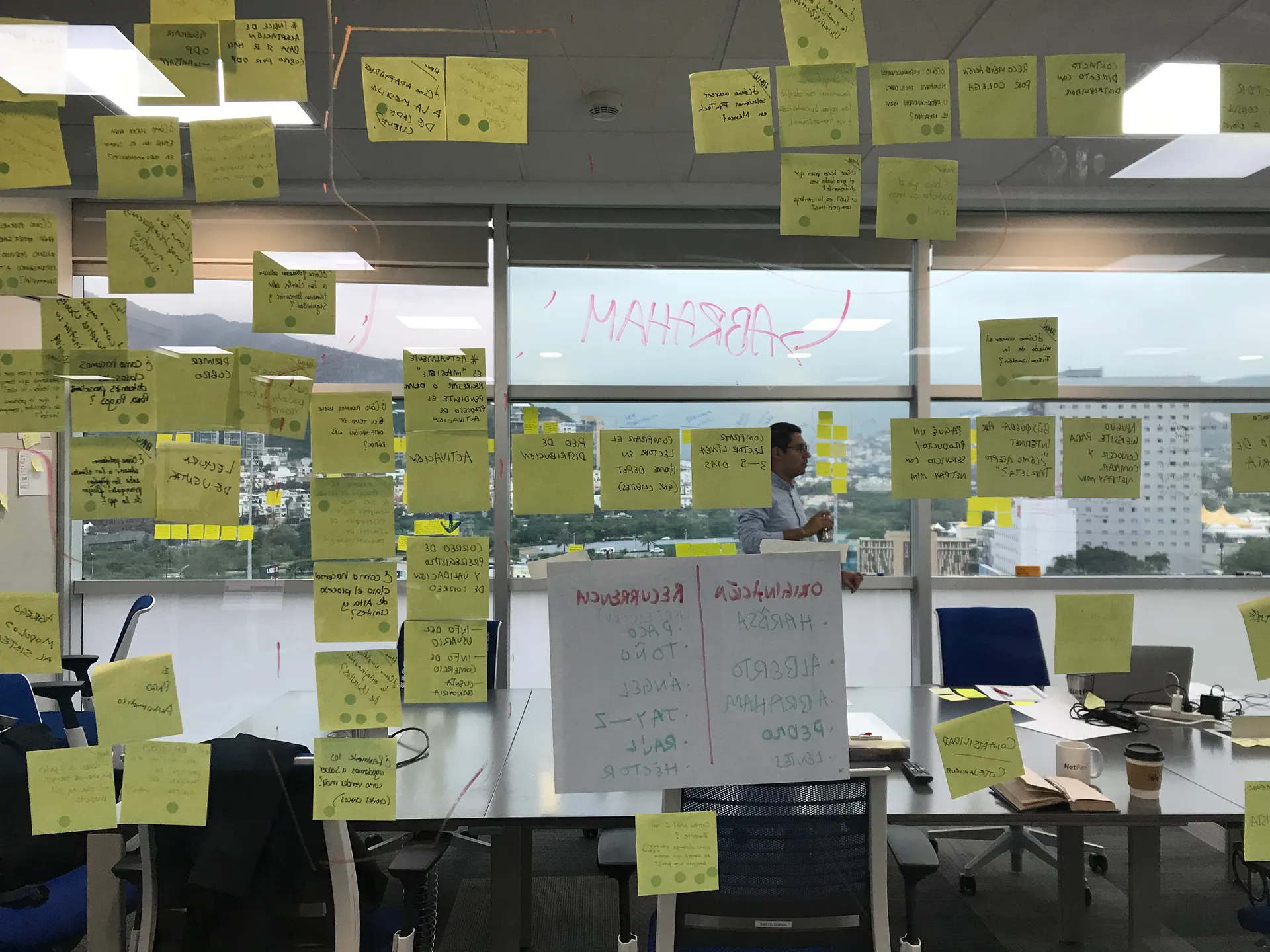
From plans to execution: Why modern management consulting firms must include a software development practice to increase their competitiveness.
Management consulting is a services industry that has become more and more commoditized due to its dynamics: from value-added to time and materials, with consultant timesheets where people talk and talk about what to do. There’s huge potential in the industry, where companies as end clients seek third-party support for input on strategic matters to transform any organization: the bigger the company, the more reliance on outsiders.
State of management consulting
In the management consulting space, quality has always been related to high premiums — ironically, technology reduces the cost of building or owning solutions in many industries. At the same time, the cost of creating technology is being distributed by leveraging economies of scale, recognizing that qualified talent is available everywhere in the world at multiple price points.
In recent decades, the practice has deteriorated due to an expansion in technology requirements and in the tools available for any CxO to autonomously decide what to use and run it within their department. The consulting approach of designing a playbook and sharing it with the client is less valuable than before. The uncertainty and lack of clarity in a changing world, along with increasing competition in every industry, require companies to continuously evolve toward new solutions and value propositions. Where a plan on paper once served as a guide for clients, today's companies’ needs rely on execution and the complex, ongoing exploration of new business models, relating the concept of ‘modern organizations’ to their high efficiencies. A plan becomes irrelevant if those who are defining the strategy cannot execute and deploy those ideas to confirm the veracity, potential, and real impact of the verbally agreed plans.
More and more companies need support with tech implementation and execution to pursue optimization and stay continuously relevant to their markets.
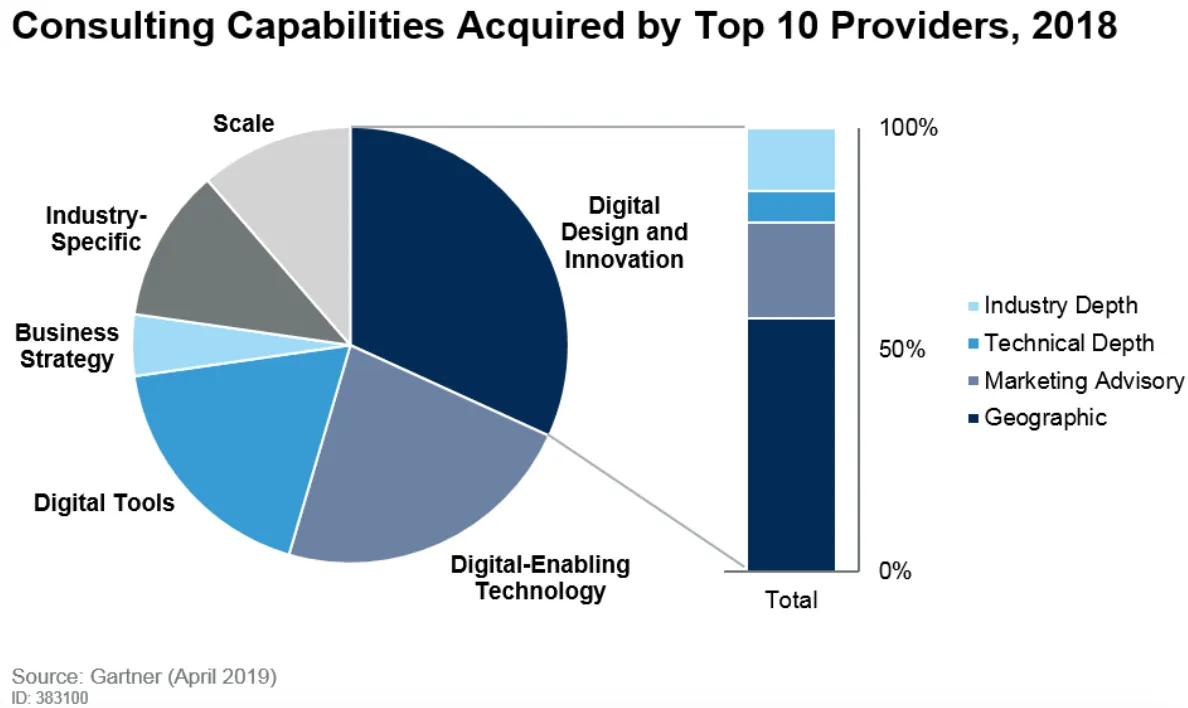 Source: Gartner, April 2019.
The real struggles on the management consulting side are:
- A severe engineering talent shortage, which forces them to compete with digitally native companies to attract talent,
- Embedding an engineering culture strong enough to retain talent and permeate the entire company,
- Accelerating their build practice to stay relevant among competitors, market conversations, and their demands, and
- Earning the first case studies and credentials to expand their tech business opportunities — the chicken-and-egg problem.
Why consider a software arm in management consulting?
The opportunity to integrate software and technology practices into the management consulting world is imperative today. Any company (a potential client in this case) that wants to thrive and succeed will need to optimize and diversify from a business model standpoint. That’s where the management consulting practice, beyond understanding and discussing potential plans, is required to extend to a point where technology and its implementation need to be discussed and, even more, deployed.
Management consultants are required to understand the business, strategy, and now technology. If you don’t understand the basics of product development, build vs. buy situations, SaaS offerings, and others, the management consulting practice's offering will become irrelevant to the many companies that need strategic and transformational support.
Integrating that expertise becomes a bridge between the plan and the execution. Applied to a management consulting firm, it will allow the business to extend its spectrum of services and add value for current and new clients.
Opportunities with distributed software teams
When we talk about distributed software teams, we might be referring to different approaches. In this context, we are talking about the opportunity to either include a software development unit within the management consulting firm's premises or explore collaboration with a software development firm to build long-lasting relationships and drive more business.
The more decentralized the team, the better from a pricing and competitive standpoint, taking advantage of multiple regions and, therefore, economies of scale. Concentrating a team in a single region will only allow a company to serve that single market. Having teams in multiple locations can help the business serve the same region but at different price points or, even better, expand the business into other market regions.
In no particular order, the following list may serve as a reference for the opportunities available once a distributed software practice is integrated into a management consulting business:
Win more deals
A company becomes more competitive without sacrificing any quality by partnering or by building its software development unit. The company will present a new set of tech services, with a flexible price point depending on team members' locations.
Integrate a build capability
Starting a technology and development line of business is not an easy task. Partnering with a company might accelerate the process by mirroring its proven experience building software products in multiple industries. However, with multiple deals flowing, the business should show success stories from its own portfolio.
Expand your capacity on demand
Using development partners, you can adapt your operation to your clients' needs and your pipeline cycle. When you have your own unit, it needs to be monitored because of all the costs involved, so a capacity plan needs to be in place, whether for clients or for internal tools built for innovation purposes.
Access to intellectual capital (& business expansion)
Bring world-class talent from regions you haven’t explored and leverage economies of scale as your competitive edge, maintaining your quality and service above the rest of the market. Again, if you concentrate on one region, you might only be serving that specific region.
Extension of lifetime value in the portfolio
Extend lifetime value in your client portfolio and your company, and create value-added with additional tech services that will fortify your current offering and help your customers in the long run. Being there will provide a better sense of potential upselling and cross-selling opportunities. Although this increases engagement risk, it leads to a better outcome for both organizations involved in the process.
Decentralized unfair advantage
Maintain your standard of quality and take advantage of the proximity, cultural affinity, and alignment that you can find with specific regions, whether to partner with software companies or to build your development unit.
How to implement this?
Any management consulting firm will require a software and technology unit. Not necessarily one operating internally, but at least a plan to collaborate with companies that might extend its current offering. Similar cultures, similar philosophies, and going to market together.
There’s a variety of connections that can be made between management consulting frameworks and technology practices. Making the right ties will allow the consulting group to retain its current client portfolio, continuously add value, allow its clients to redefine themselves, stay relevant, and, in the end, become a favorable dependency for its clients' continued success.
Combined value-added of consulting and software dev
One of the many advantages of this combination relates to the commoditized conversations in the consultancy and software spaces. Engineers are perceived as a commodity due to time-and-materials conversations and the fact that you can find engineers practically everywhere. The same happens with consultants. The big difference is finding the right person for the job to be done.
In this scenario, a group of business experts with tech knowledge, working closely with engineers who understand a specific industry, its challenges, and the solutions available out there, is the best combination to thrive in the current, transformational world of business.
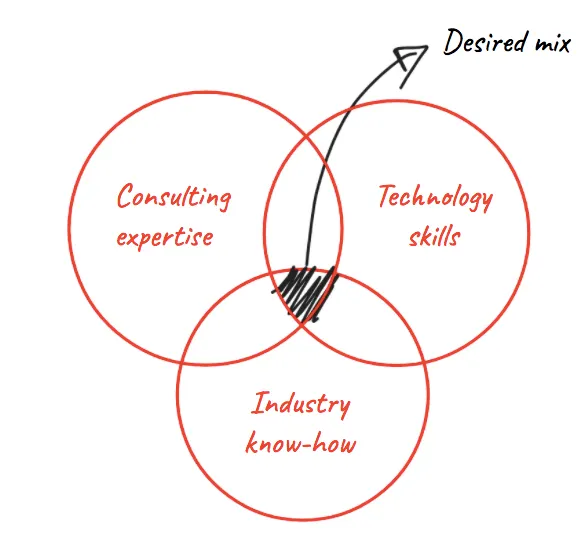 A set of capabilities that, combined, add value in the consulting space.
The distributed strategy becomes relevant when a company has reached a defined size in a scaling phase and wants to compete with bigger organizations that already have resources and tested strategies. It allows the company to increase its operations and tech capacity while optimizing costs and becoming more efficient, with multiple offices and employees from different backgrounds.
This world-class practice can be taken as a reference, and an implementation can be done on a smaller scale. Whether you want to hire your first engineers on your premises, hire people overseas to reduce the exorbitant cost of consultancy, or perhaps work with an international partner that serves as a proxy and facilitates those interactions, the consultancy world's transition to an execution mindset is happening.
If you want to explore the possibility of building an internal software development unit for your management consulting practice, please send an email to eduardo@icalialabs.com.